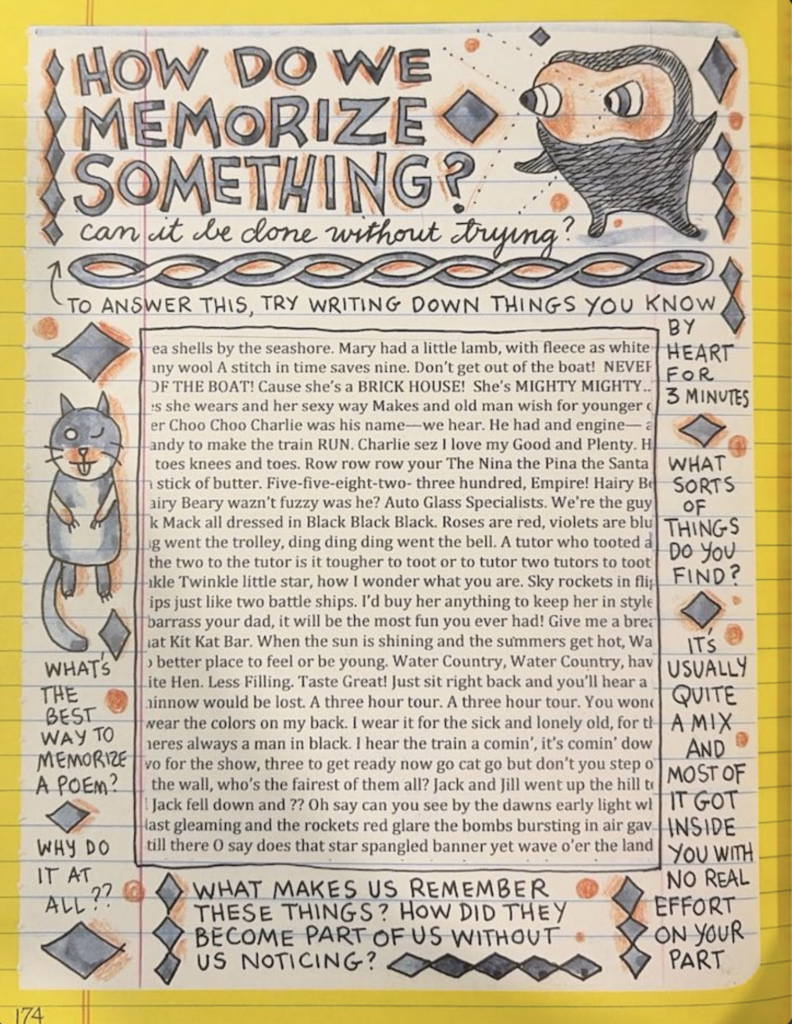
I like memorizing things, all kinds of things.
…
A memorized poem, list, or section of music gives my attention something to return to in stray moments. Waiting in line, waiting for the pot to boil… I latch my mind onto my current object of memorization and let it sit there a minute or two.
Sometimes the value of having this kind of mental anchor resides not so much in what I’m memorizing but in what I’m not thinking about instead… The object of memorization grounds my attention, preventing my thoughts from wandering off into whatever darkness my subconscious would otherwise have dredged up for rumination. And, using memorization to babysit my attention leaves my mind in a much more refreshed state than if I’d used a screen for the same purpose instead.
Memorization offers me a glimpse of what it might be like if I could escape my own mind. Especially as algorithms become better and better at showing me more stuff that’s already like the stuff that I like, and spending time on my phone feels ever more like interacting with my own brain. In order to memorize, I must conform my thoughts so very very closely to the product of someone else’s imagination—noticing a chord or a word here, a turn of phrase there, that I would never have thought of. In this way, the activity of memorization offers my mind some relief from the dreariness of being itself again and again everyday.
…
And this close conforming of my mind to something else is part of why I especially like memorizing the music that I perform, even when I don’t “have to.” Memorizing causes me to notice things I would never otherwise have noticed. When, during the memorization process, I try to reconstruct the music from memory and come up partially blank, the gaps reveal the details that have so far slipped past. The more of these details I notice, the richer and more informed my interpretation of the music becomes. Oh, this section is in 12/8 but this similar part is in 6/8. What implications does that have for my understanding of the composer’s intentions? What can I do to show that difference?
Chopin is said to have said that playing someone else’s music from memory was arrogant because it made it look like you were improvising. But I find that if I don’t know what I’m performing well enough to present it comfortably from memory, I’ll be disappointed by my performance anyway.
…
It’s worth mentioning that intelligence is not a product of the mind’s contents, and I’m under no delusions that memorizing a bunch of stuff will make me any smarter.
But I think there are intellectual benefits. Memorized facts act like hooks, capturing information as it flows past, allowing me to notice new connections and relationships between ideas. And though I doubt I’ll ever take my love of memorization to the extreme, I do enjoy the specific aspect of memorization that concerns pushing the limits of what my brain can do. To memorize, I look for repetition so I can organize the memorized content into chunks. Do this again and again and pattern recognition becomes much easier—reflexive, even. And recognizing the patterns underlying the structure of a poem or a piece of music is fun, not just because it reveals something about the poem/music/whatever, but also because of the joy of discovery that accompanies the searching and finding of these patterns.
…
Many music students find memorization stressful. This is understandable, since often the pressure to memorize originates from an outside source (e.g. an audition requirement) rather than internal curiosity.
My hope as a teacher is that I can model a more positive attitude—
Memorization is a process that we can use to understand more about the memorized object, the mind of its creator, and also something about the way our own minds work. Memorization presents an opportunity to meditate on things that are beautiful and excellent and external to oneself—key, as I’ve noted before, to maintaining a rich imagination fertile for creativity.